 QuantumSeed
Intel has signed a definitive agreement to acquire Classiq. Intel did not disclose terms. Closing is expected in H1 2027, subject to regulatory approvals and customary closing conditions.
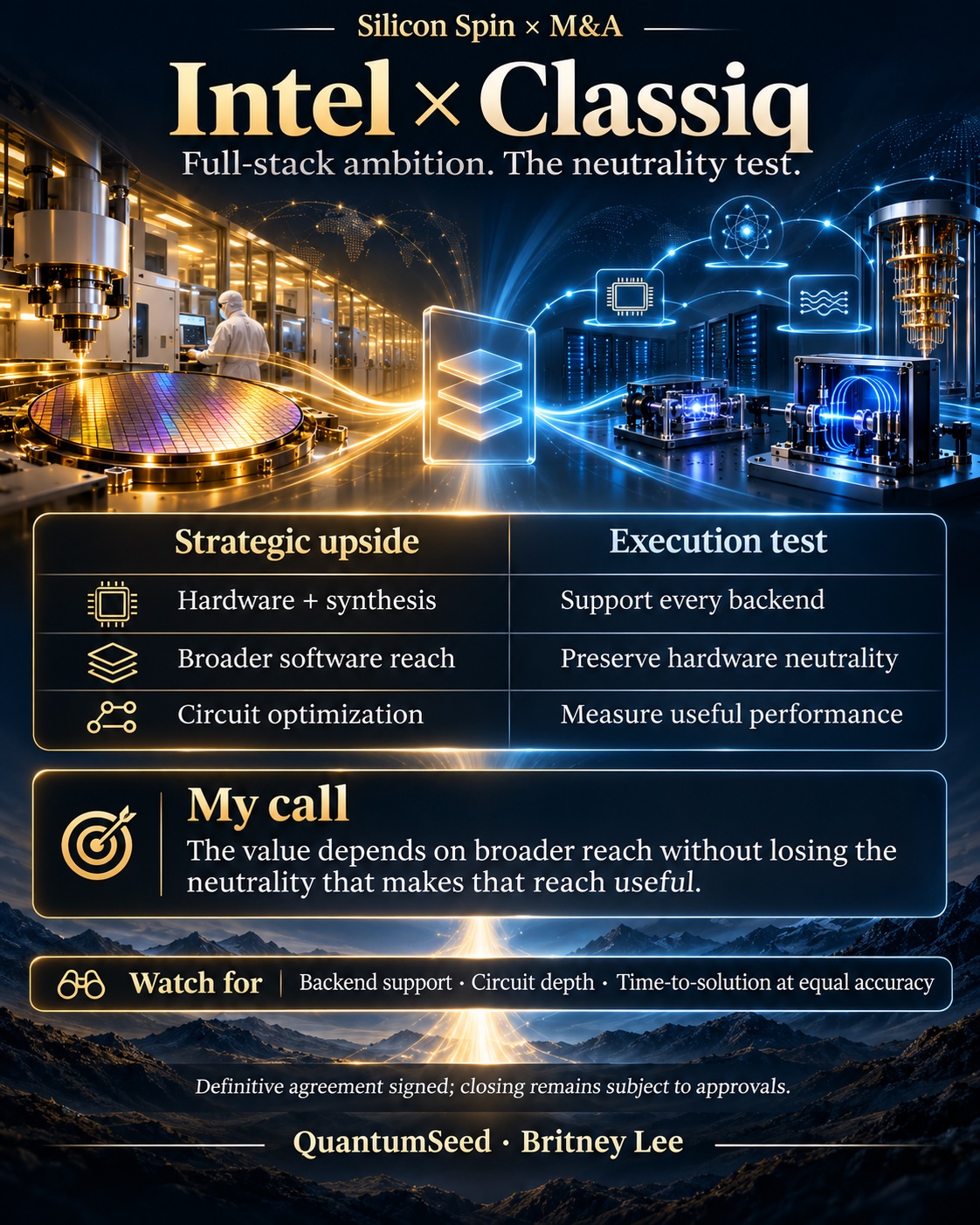
The EDA comparison in Intel's announcement is particularly significant.
In semiconductors, design automation helps engineers turn complex ideas into implementable circuits. Classiq addresses a related challenge in quantum computing: translating high-level functional models into optimized quantum circuits that can run on different hardware platforms.
Bottleneck addressed
Classiq translates high-level quantum models into optimized circuits, helping developers work within hardware constraints.
What changes in the competition?
Software capabilities: a proposed expansion.
Fidelity, scale, error correction and manufacturing yield: no new evidence disclosed.
This announcement alone does not establish a hardware leap over superconducting, trapped-ion or other platforms.
My take
Intel says it intends to maintain Classiq's hardware-agnostic approach after closing. If that holds, its software reach could extend beyond customers choosing Intel's own QPU.
The strategic upside is broader reach. The risk is losing the neutrality that makes that reach valuable.
What I'll track
- Do competing hardware backends keep receiving timely support?
- Does optimization reduce native gate count or circuit depth?
- Do those savings improve time-to-solution at the same accuracy?
That is where a software acquisition could translate into a measurable competitive advantage.
Source
Intel official announcement · October 26, 2026 ↗
Transaction details and stated intentions come from Intel's announcement. Competitive implications reflect the author's assessment.
← All Founder's Insights