 QuantumSeed
PHOTONIC INTERCONNECT × M&A
Same light, two eras
What Marvell–Lumentum tells us about quantum interconnects
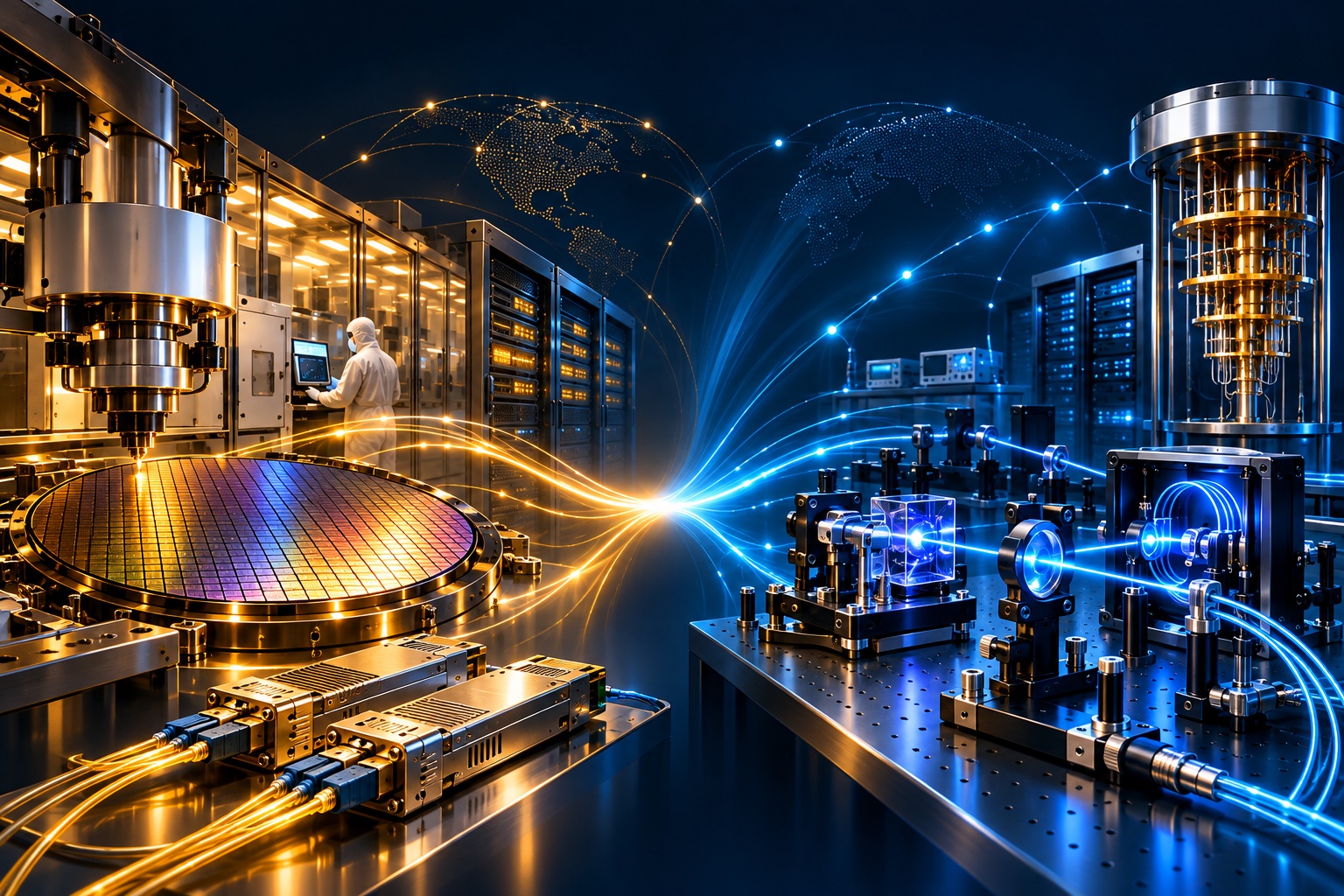
AI optics
At industrial scale
- Photonic chips
- Optical interconnects
- Packaged modules
- Factory capacity
- Global supply chain
- Powering AI infrastructure
From fabs to global AI infrastructure
Quantum interconnects
At an early stage
- Single-photon sources
- Trapped ions and quantum memories
- Photonic links
- Lab-scale modules
- Emerging infrastructure
- From experiments to networks
From labs to a quantum internet
| The question | AI optics | Quantum interconnects |
|---|---|---|
| Physics or manufacturing? | Manufacturing | Still physics |
| Who owns capacity? | Buyers are locking it up | Each builder, at lab scale |
| Business model? | Buy the fab | Waiting for its foundry |
Watch for: a tier-1 optics supplier launching a dedicated quantum line or signing a capacity deal.
I read quantum through a semiconductor lens.
My question is not simply: what is the latest technical record?
Is this still a physics problem—or has it become a manufacturing problem?
AI optics: already a manufacturing race
- Bloomberg reported that Marvell is in advanced talks to acquire Lumentum. No final deal has been announced by either company.
- Lumentum has said its optical-networking capacity is effectively sold out through early 2029.
- NVIDIA invested $2 billion in Lumentum and another $2 billion in Coherent in March 2026, alongside multiyear purchase commitments and future capacity access.
When capacity becomes scarce, strategic control starts to matter as much as component performance.
That is what makes the Marvell–Lumentum story interesting. This is no longer only about better optics. It is about who controls lasers, photonic components, packaging and manufacturing capacity as optical infrastructure becomes strategic.
Quantum interconnects: still earlier
- IonQ announced in April 2026 that it had photonically interconnected two independent commercial trapped-ion quantum systems.
- Nu Quantum raised a $60 million Series A in December 2025, which the company described as the largest financing round for a pure-play quantum networking company.
- Critical components—from photon sources and memories to detectors, networking and interconnect technologies—are still often developed inside individual platforms.
In semiconductor terms, the industry still looks closer to the IDM era than to a mature foundry ecosystem.
Two paths toward the same infrastructure layer
The key question is no longer simply:
“When does quantum get its own foundry?”
The better question is:
Which side reaches scalable photonic infrastructure first?
Path 1 — Optics → deeper vertical integration
Marvell–Lumentum / Coherent represent the industrial optics side.
The manufacturing base already exists. AI demand is pushing that supply chain toward tighter control of laser supply, photonic components, packaging, manufacturing capacity and system integration.
scale demand → capacity becomes scarce → strategic buyers secure more of the supply chain
This is an existing optical manufacturing ecosystem becoming more vertically integrated.
Path 2 — Quantum → infrastructure
IonQ is approaching the same problem from the opposite direction.
A quantum-native company has used acquisitions to assemble capabilities across quantum networking, photonics, memories, detectors and optical communications infrastructure. Its acquisitions include Qubitekk, ID Quantique, Lightsynq, Skyloom and Nexus Photonics.
buy missing capabilities → integrate the stack → standardize it → potentially externalize the infrastructure
That last step is the one that matters most.
If those acquired capabilities remain captive inside IonQ, the model stays close to a quantum IDM.
If IonQ increasingly supplies photonics, networking or manufacturing capabilities to external quantum customers, it begins to evolve toward an infrastructure / foundry-like model. IonQ's September 2026 Nexus Photonics announcement is particularly important because the company explicitly described an external merchant-supplier and quantum-photonics-foundry direction through SkyWater.
The convergence
These are not simply two different corporate strategies.
They are two directions moving toward the same middle layer.
Optical supply chain → more integration → quantum-capable infrastructure
versus
Quantum company → more integration → externalized infrastructure
One starts with manufacturing scale. The other starts with quantum system knowledge.
The end-state is still open—and both paths could coexist.
My call
Quantum interconnects may not follow semiconductor history in a straight line.
The winner may not be the company with the next entanglement-rate record.
It may be the company that first creates a repeatable, scalable interface between quantum systems and industrial photonics.
What matters now is manufacturing speed, repeatability, standard interfaces and external customers.
That is when a proprietary technology starts becoming infrastructure.
Watch for
- Tier-1 optics suppliers launching quantum-qualified products or dedicated capacity
- Quantum companies externalizing internally developed photonic or networking capabilities
- Common interfaces adopted by more than one quantum hardware platform
- External customers using the same photonic manufacturing or packaging platform
- AI-photonics manufacturing capabilities beginning to cross into quantum applications
Risk to the thesis
Quantum architectures may remain too heterogeneous for shared infrastructure. If that happens, vertical integration could persist much longer than semiconductor history suggests.
Revisit
When Marvell–Lumentum terms are announced—and when the first meaningful external quantum customer appears for an emerging photonics or manufacturing platform.
Sources
- Bloomberg · Marvell–Lumentum talks · October 28, 2026 ↗
- NVIDIA × Lumentum · March 2, 2026 ↗
- NVIDIA × Coherent · March 2, 2026 ↗
- IonQ photonic interconnect milestone · April 14, 2026 ↗
- Nu Quantum $60M Series A · December 10, 2025 ↗
- IonQ × Nexus Photonics · September 10, 2026 ↗
Transaction status and company disclosures are cited above. Strategic comparisons and industry implications reflect the author's assessment.
← All Founder's Insights