 QuantumSeed
PHOTONIC QUANTUM · MANUFACTURING
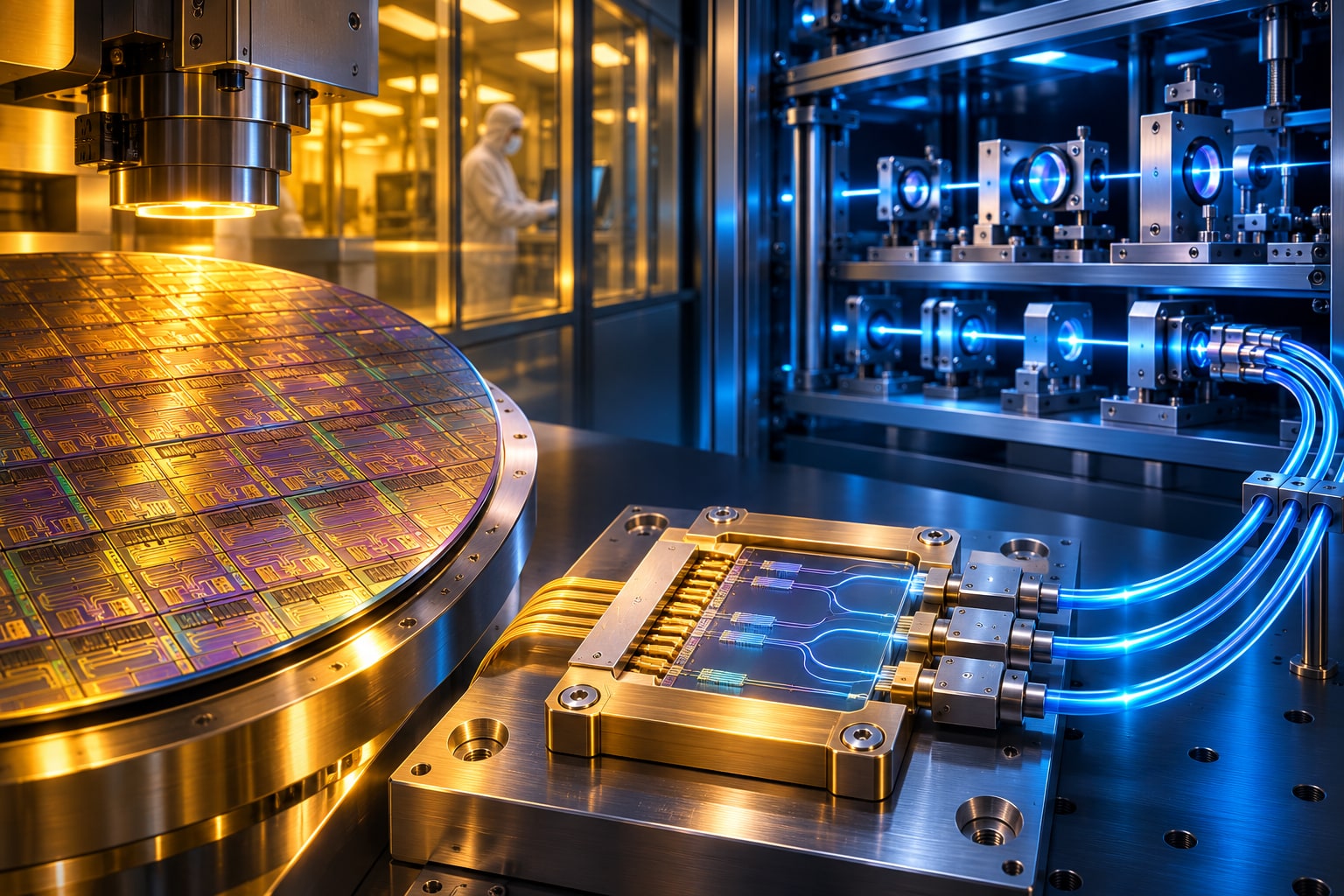
Manufacturing is part of the architecture.
PsiQuantum · From photonic devices to repeatable systems
01
Fabricate
- Low-loss photonic devices
- Repeatable processes
02
Package
- Stable optical coupling
- Detector integration
03
Validate
- Module-level tests
- End-to-end loss budget
Watch for: Optical loss · Coupling stability · Packaging yield
A manufacturable photonics platform shifts attention toward optical loss, packaging, testing and system-level validation.
For photonic quantum computing, the question of scale starts with the device and continues through fabrication, packaging, connectivity and verification. This is why PsiQuantum’s manufacturing-led approach is relevant to a semiconductor supply-chain investment framework.
What the research establishes
The PsiQuantum team’s 2025 Nature paper describes integrated silicon-photonics modules for generating, manipulating, connecting and detecting photonic qubits. It reports 99.98% ± 0.01% state preparation and measurement fidelity and 99.72% ± 0.04% chip-to-chip qubit-interconnect fidelity.
These figures are conditional on photon detection and exclude loss. They are component and module benchmarks, not evidence that a large-scale fault-tolerant computer has already been delivered.
What manufacturing must solve
My investment interpretation is that repeatability matters as much as a headline demonstration. Optical loss, coupling stability, detector integration, packaging yield and production testing need to work together across a system. A high component fidelity does not by itself establish an acceptable end-to-end resource budget.
The relevant diligence therefore asks which processes have been qualified, how performance varies across devices and lots, how packaging affects the loss budget, and which tests detect failures before system assembly.
AI photonics and quantum: evaluate the overlap
AI optical connectivity and photonic quantum computing may draw on related fabrication and packaging capabilities. Their operating requirements and qualification processes differ. An AI supplier’s commercial revenue, transferable engineering capability and demonstrated quantum customer validation should be assessed separately.
For Taiwan, this suggests a practical research agenda around photonic fabrication, low-loss optical interfaces, precision assembly and testing. It does not establish that any specific local supplier is already qualified by PsiQuantum.