 QuantumSeed
Logical reliability, resource overhead and useful throughput belong at the centre of quantum scaling assessments.
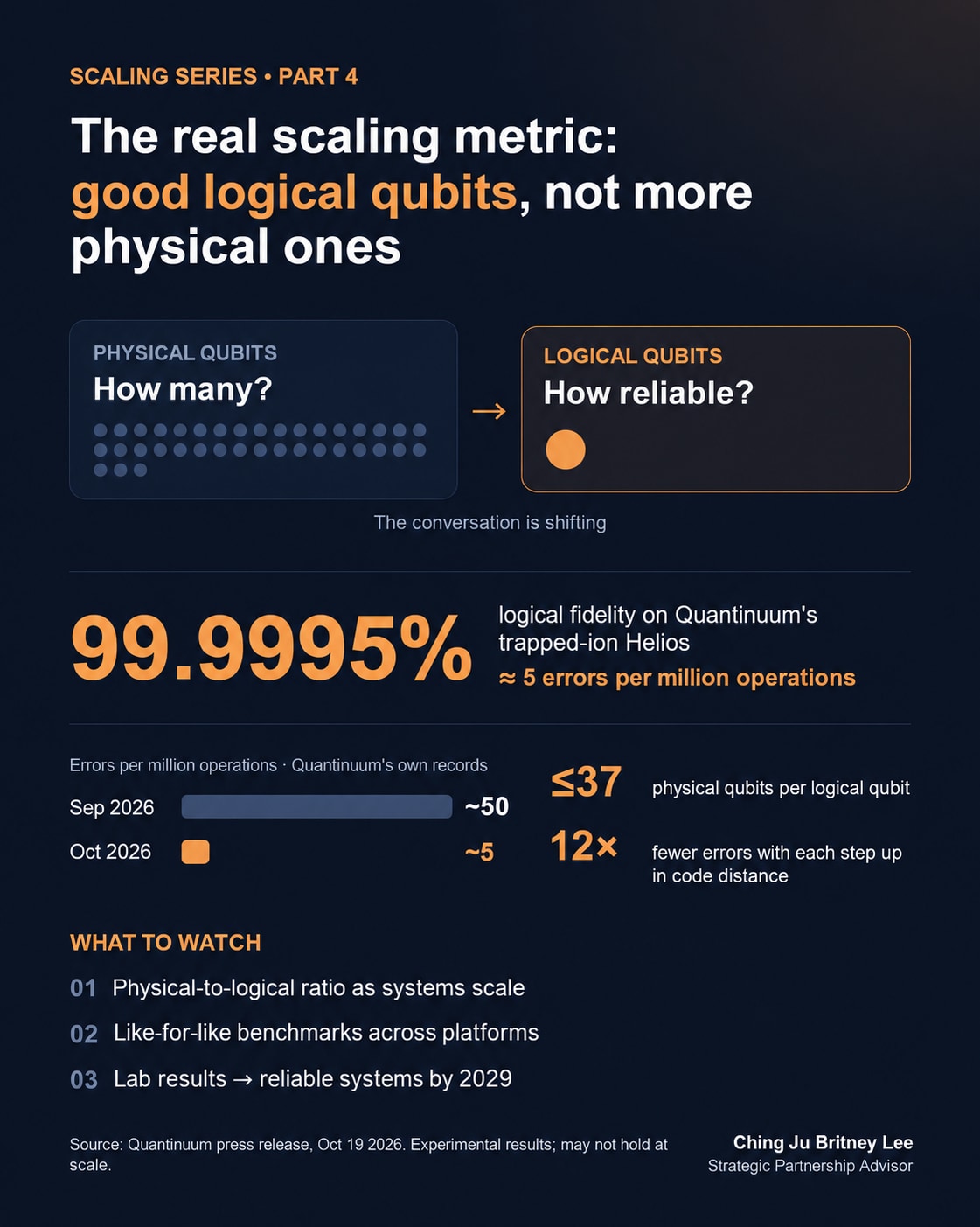
More physical qubits are only one part of the scaling story. The more useful question is how reliably a system can preserve and process logical information, and what resources it takes to do so.
What the reported milestone measures
On October 19, 2026, Quantinuum reported 99.9995% logical memory fidelity on Helios using its error-correction architecture. Its accompanying explanation describes approximately five uncorrectable errors per million operations in that memory experiment and a tenfold reduction against its September record.
The scope matters: a logical memory benchmark does not establish the same error rate for every logical gate, a complete application or an arbitrarily long computation. Claims across architectures require comparable workloads, error definitions and resource accounting.
What to track next
My assessment framework asks four questions: Does error suppression improve as protection increases? How much physical hardware and execution time does each reliable logical operation require? Can the controller and decoder sustain the workload? Does the advantage persist in logical gates and meaningful circuits?
A resource ratio on its own is incomplete. Encoding, connectivity, ancillas, decoding and the target error budget all influence the hardware a useful machine will need.
Where the supply-chain opportunity sits
For Taiwan, the investment lens extends to chip design, control and readout electronics, packaging, testing and system integration. A promising engineering capability becomes investable when there is a validated requirement, customer engagement and a credible path to repeatable delivery.
The objective is to understand the cost and throughput of reliable computation, alongside the number of qubits.