 QuantumSeed
QUANTUM SYSTEMS · ENABLING LAYERS
Scaling qubits is not the same as scaling quantum computers.
Universal Quantum × SEEQC · Two different bottlenecks
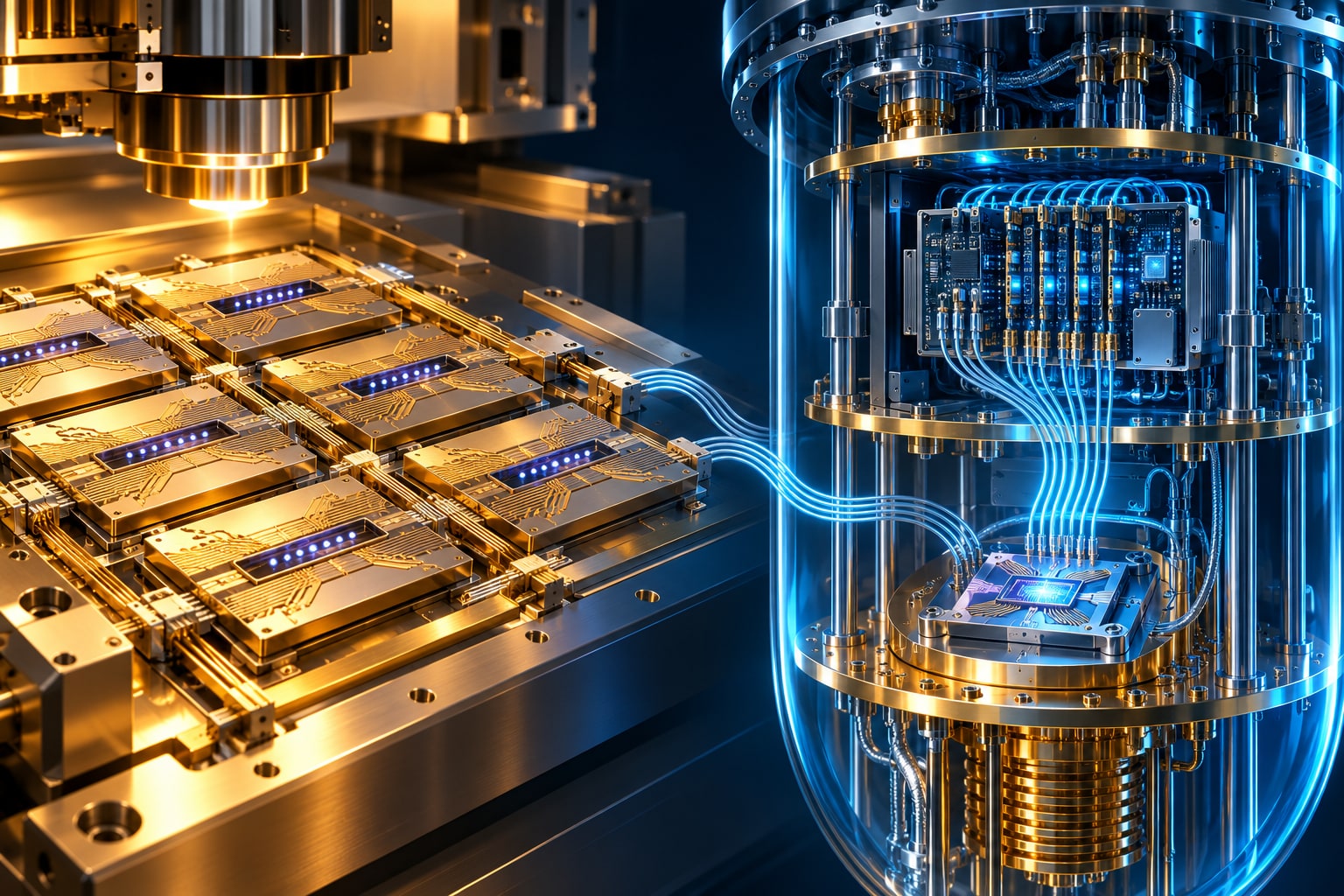
| The question | Connect modules | Control qubits |
|---|---|---|
| Architecture | Modular trapped-ion approach | Superconducting control stack |
| Bottleneck | Inter-module operation and connectivity | Wiring, heat and control latency |
| Enabling layer | Interconnects, packaging and testing | SFQ electronics and control integration |
Watch for: Inter-module performance · Control load · System repeatability
Universal Quantum just closed a $100M+ Series A, the largest ever for a UK quantum company. What stood out to me wasn't the size of the round, but where the money is going: modular architecture, chip-to-chip interconnects, and scalable control systems.
Comparing it with other approaches shows that "scaling" is not one problem. It's at least two:
Connecting modules. Within trapped ions alone, there are opposite bets. Universal Quantum tiles chips together directly, without photonic interconnects, and aims to operate at room temperature. IonQ links separate machines with photons and has already networked two commercial systems.
Controlling qubits inside each system. For superconducting platforms, the bottleneck is getting control signals to thousands of qubits inside a cryostat without overwhelming it with wiring and heat. SEEQC addresses this by moving Single Flux Quantum (SFQ) control electronics into the cryogenic environment.
More qubits do not automatically mean a bigger quantum computer.
From an investment and supply-chain perspective, the opportunity extends well beyond QPU developers to the enabling layers that make scaling possible:
- Cryo-CMOS, Cryo-RF, and SFQ control chips for superconducting systems
- Advanced packaging, interconnects, and specialty semiconductor processes across architectures
These are also areas where Taiwan's semiconductor and precision manufacturing ecosystem could find meaningful entry points into the global quantum supply chain.
The competition in quantum computing may not be about who builds the most qubits, but about who solves scaling for the whole system.